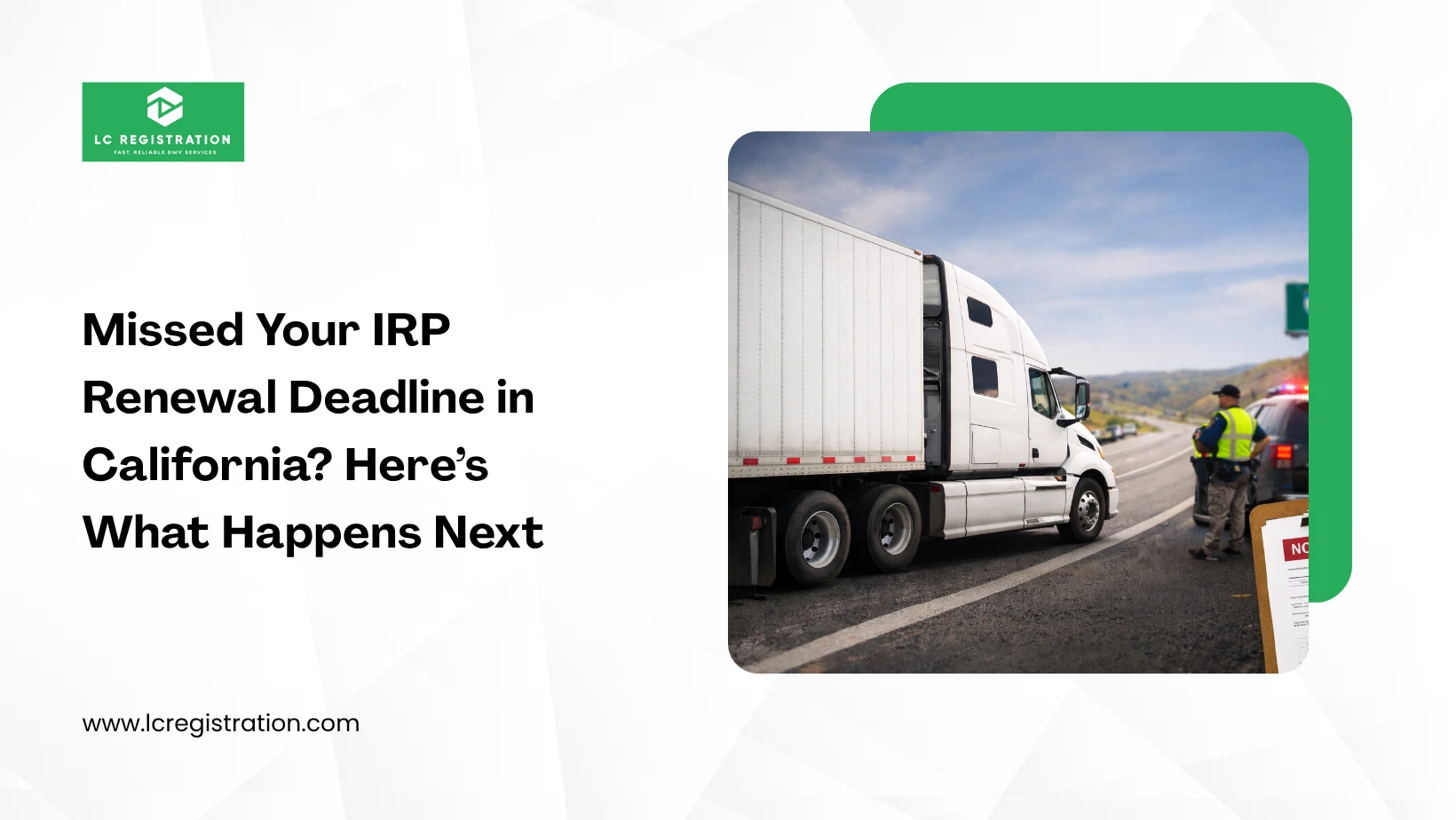
If you missed your IRP renewal in California, your truck cannot legally cross a state line today. Worse, every day you wait adds to a penalty that can reach 60% of your base fees after the 30-day mark. Letting your apportioned plates expire instantly interrupts your interstate operations, leaving your fleet sidelined at the scales while freight sits waiting.
In this guide, we break down exactly what happens after your expiration date passes, whether you can still legally dispatch your trucks, and how to reinstate your IRP registration in California fast.
What Happens If You Miss the IRP Renewal Deadline?
Once midnight passes on your expiration date, your credentials are no longer valid for normal apportioned operation. The California DMV does not offer a buffer to finish out your current route.
Your Registration Is No Longer Current
In practical terms, expiration means your physical cab card is no longer valid. Any California Highway Patrol (CHP) officer or out-of-state weigh station operator who runs your DOT number or checks your cab card will immediately see that your commercial registration has lapsed.
Risk of Citations, Delays, and Downtime
Choosing to move freight on expired credentials invites immediate business disruptions:
- Weigh stations: Getting pulled over and cited at interstate scales.
- Roadside inspections: Failing DOT inspections that actively damage your carrier safety score (CSA).
- Delivery disruption: Having your truck placed Out of Service (OOS) on the side of the highway.
- Lost dispatch time: Frustrating customers with delayed freight while you scramble to pay fines.
Late Fees and Penalties
Penalties are automatically triggered by the DMV system, and the financial exposure grows the longer you wait. Under California DMV fee structures, penalties escalate quickly. As mentioned in the Official IRP Registration Plan:
- 10 days late or less: 10%
- More than 10 days up to and including 30 days: 20%
- More than 30 days up to and including one year: 60%
- More than one year up to and including two years: 80%
- More than two years: 160%
Furthermore, if a vehicle was operated even once after the expiration date, you cannot simply delete or withdraw it from your fleet to dodge the late fees. The state will assess the full renewal and penalty fees for that withdrawn vehicle, and no refunds will be issued.
Is There a Grace Period for Late IRP Renewal?
No, there is absolutely no enforcement grace period for late IRP renewals in California. If you are pulled over the day after your cab card expires, you will be cited. However, there is a distinct difference between “late renewal is still possible” and “you are still legal to operate.”
Expired Does Not Always Mean the Account Is Permanently Lost
A missed deadline does not mean the state has permanently deleted your motor carrier account. Late renewals can still be processed, and you can retain your current plates. Submitting a late payment does not erase the compliance gap, though; your trucks must remain parked until the state actually issues your updated cab card.
Why Carriers Get Confused About Grace Periods
Carriers frequently misunderstand expiration rules due to:
- Renewal notice timing: Assuming that if the DMV mailed the physical billing notice late, the deadline was extended.
- Internal bookkeeping delays: Believing that dropping a check in the mail equates to “active status.”
- Assuming payment equals compliance: The DMV must actually process the payment and generate the cab card before you are legal to drive.
What To Do Immediately If You Missed the Renewal Deadline
If your cab card has expired, pull the truck off the road and follow these exact steps.
Step 1: Stop and Confirm Your Current Status
Check the physical cab card in the truck and verify the exact expiration date. Next, check your motor carrier account or your DMV vehicle registration records to ensure your accounting department hasn’t already paid the invoice.
Step 2: Review the Renewal Notice and Account Requirements
Locate the official billing invoice that the DMV sent you. Check what the invoice says you owe, look for any missing balances from previous years, and note any fleet changes that will affect your final renewal cost.
Step 3: Submit the Renewal as Soon as Possible
Filing promptly is the only way to prevent late fees from escalating. You must submit your actual mileage reports (Schedule B) for all jurisdictions. Expect strict formal documentation requirements.
Step 4: Pay Outstanding Fees
You cannot piecemeal your payments. You must pay your base apportioned renewal fees for all states, the mandatory late charges, and any unpaid prior amounts in one lump sum before the state will reinstate your account.
Step 5: Respond Quickly to Any DMV Follow-Up
The DMV will halt your renewal if they spot an error. Be prepared to quickly provide clarification on missing mileage, changes to vehicle weight, or insurance-related issues if an auditor flags your file.
What Documents May Be Needed for a Late IRP Renewal?
Gathering the exact right paperwork prevents your application from being rejected and pushed to the back of the line.
Basic Renewal Documents
At a minimum, you will need:
- Your official DMV renewal billing notice.
- A copy of your current (expired) cab card and registration details.
- Vehicle unit information for the fleet (Schedule A).
- Your actual reported mileage and jurisdiction details (Schedule B).
What if you never received your renewal notice?
The DMV does not accept “it got lost in the mail” as an excuse for a late filing. If you did not receive your official billing documents, you must proactively apply by submitting the following documents:
- Schedule A/B
- Schedule C
- VIN Verification (If adding a vehicle or making a correction)
- Proof of payment or exemption of FHVUT (If applicable)
- Agreement to Maintain Records
- Agent authorization (If applicable)
- Lease agreement (If applicable)
- Proof of insurance
Additional Documents for Problem Cases
If your fleet has changed or you have compliance flags, you must provide:
- Corrections to fleet records (Schedule C to add/delete vehicles).
- Proof of ownership, title documents, or stamped Heavy Highway Vehicle Use Tax (Form 2290) for heavy trucks.
- Supporting records to explain any sudden drops or spikes in reported mileage.
Why Missing Documents Delay Reinstatement
An incomplete file guarantees downtime. If you forget to attach a Schedule C for a sold truck, the DMV will pause the review, mail you a correction notice, and force a back-and-forth clarification process that keeps your active trucks parked for weeks.
How Much Can a Late IRP Renewal Cost?
Missing a deadline hurts your profitability in three distinct areas.
Standard Renewal Fees
You are still responsible for your base apportioned renewal charges, which are calculated by multiplying the California registration fee by your California mileage percentage, plus the fees for other states you operate in.
Late Penalties
Late penalties increase from 10% to a massive 160%, depending on how many days past due you are. On top of those percentages, you will also be hit with a strict $250 fee per vehicle for every single month that passes between your expiration date and the day you finally submit your application.
Indirect Business Costs
The fees are nothing compared to the operational hit. True costs include equipment downtime, missed loads, driver scheduling issues, and the extra administrative time spent sitting on hold with Sacramento.
Common Mistakes Carriers Make After Missing the Deadline
Avoid these standard pitfalls to ensure your reinstatement goes smoothly:
Assuming There Is an Automatic Grace Period
Believing you have a 30-day cushion to operate is a myth that leads directly to citations.
Waiting Too Long To File
Holding off on filing because you don’t have the cash for the fees only ensures the penalties will increase.
Operating Before Credentials Are Resolved
Crossing a state line without a valid cab card usually results in an Out-of-Service order.
Ignoring Small Account Errors
Leaving a typo in a VIN or failing to update an address guarantees the DMV will reject the renewal packet.
Using the Wrong Permit as a Fix
Buying a standard California trip permit does not retroactively fix an expired IRP account.
Trying to Use Planned Non-Operation (PNO) Status
Many California carriers try to file a standard Planned Non-Operation (PNO) to avoid fees on a parked truck. However, the official DMV handbook explicitly states that PNO status does not apply to vehicles registered under the IRP. If your truck is parked and expired, you must use an IRP-specific Certificate of Non-Operation (CNO) and submit it within 90 days of expiration to be valid for penalty waivers.
When To Get Professional Help
Trying to resolve a lapsed apportioned account at a local DMV branch is usually a dead end, as local clerks rarely handle complex commercial fleet compliance. By the time your account is late, it is usually time to bring in an expert.
Situations Where Outside Help Makes Sense
You should engage a professional service if you are dealing with:
- Multi-vehicle fleets that require complex Schedule A/B/C adjustments.
- Long-expired renewals facing massive penalty calculations.
- Prior citations for operating out of compliance.
- Record corrections that keep getting rejected by Sacramento.
- Urgent operating needs where every day parked costs you thousands.
How a Registration Service Can Help
This is exactly where LC Registration steps in. Based in Ontario, California, our licensed team specializes in complex DMV vehicle registration and commercial fleet compliance. We bypass the standard DMV lines to help you by reviewing your paperwork, identifying missing items before submission, coordinating the actual filing, and drastically reducing avoidable delays.
Whether you need an urgent IRP renewal or manage a fleet that qualifies for Permanent Fleet Registration (PFR), we ensure your paperwork is accurate, keeping your trucks on the road. Contact the experts at LC Registration today for fast, reliable help with your IRP renewal and get your fleet legally back to work.
FAQs About Missing an IRP Renewal in California
What happens if my IRP expires in California?
Your apportioned credentials immediately become invalid. You cannot legally operate your commercial vehicle in multiple jurisdictions until you file a late renewal, pay all penalties, and receive an updated cab card.
Can I still drive with an expired IRP cab card?
No. Operating with an expired cab card is illegal and exposes you to DOT citations, fines, and the likelihood of your truck being placed out of service.
How do I renew IRP after the deadline?
You must submit your updated Schedule B mileage records, pay your base apportioned fees, and cover all accumulated late penalties. Using a licensed service, such as LC Registration, can expedite this process.
Can I get a temporary permit while my renewal is being processed?
Temporary options for apportioned vehicles are extremely limited and complex. You cannot get a standard temporary permit simply to avoid paying a late bill, as IRP involves multi-jurisdictional fees.
How much are late IRP penalties in California?
Penalties scale based on time. Standard penalties add 10% to your license and weight fees if 1-10 days late, 20% if 11-30 days late, 60% if 31-365 days late, and up to 160% if over 2 years late.