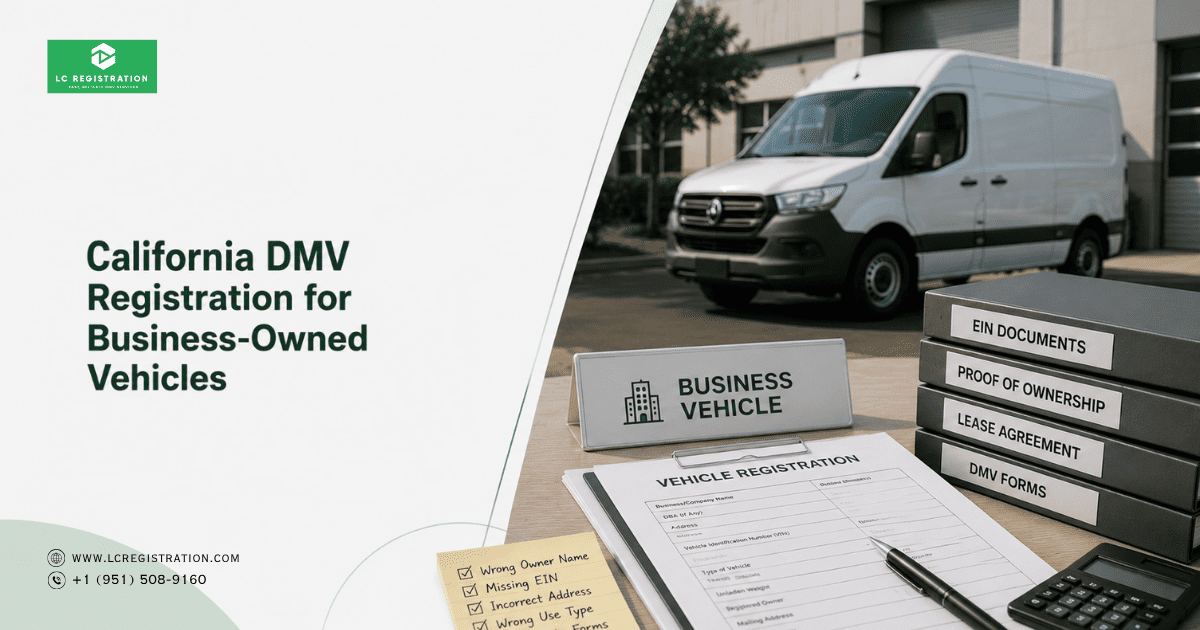
Many California small business owners, from contractors and tradespeople to delivery drivers, are unknowingly operating commercial vehicles under personal registration. It seems like a minor paperwork detail until a traffic stop, a roadside inspection, or a denied insurance claim makes it a very expensive mistake. The reality is that California’s DMV doesn’t just classify large fleet trucks as commercial; even a single pickup or cargo van used for business can require commercial registration.
This guide breaks down exactly how to register a commercial vehicle in California, what the fees look like, and what steps are involved, so you can stay compliant, protected, and focused on running your business.
What Is a Commercial Vehicle in California?
The Official DMV Definition
Under California law, a commercial vehicle is broadly defined as any vehicle used primarily for business purposes — including transporting goods, tools, equipment, or passengers for compensation or profit. The DMV’s classification hinges on use, not just what the vehicle looks like or how big it is. A standard half-ton pickup truck used to haul landscaping equipment to a client’s property can qualify just as much as a full-size semi-truck.
Types of Vehicles That Qualify
Commercial vehicle registration applies to a wider range of vehicles than most people realize. Common examples include:
- Pickup trucks that are used to transport business materials, tools, or supplies
- Cargo vans and Sprinters, used for delivery routes or mobile services
- Flatbed trucks, box trucks, and service utility vehicles
- Vehicles owned by an LLC, S-Corp, or C-Corp and used for any business-related purpose
- Even standard sedans or SUVs, if they are titled in a business entity’s name
The Personal vs. Business Use Line
This is where many business owners get confused. If your vehicle is titled under your company’s name — an LLC, corporation, or partnership — it almost always requires commercial registration regardless of how frequently you use it for work. If you are an individual who occasionally uses a personally owned vehicle for minor business errands, the situation may differ, but it is still worth verifying directly with the DMV or contacting our experts at LC Registration to clear the confusion.
Who MUST Register Their Vehicle as Commercial in California?
Mandatory Registration Scenarios
California law is fairly clear about who is required to register their vehicle for commercial use. You are most likely required to do so if you fall into any of these categories:
- You own or operate a business under an LLC, S-Corp, or C-Corp, and the vehicle is titled in the company’s name
- You are an independent contractor who uses a truck, van, or car to transport goods, equipment, or supplies to job sites
- You operate in industries like trucking, construction, landscaping, HVAC, pest control, catering, or any mobile service business
- You transport people or goods for hire, even on a part-time or gig basis
Vehicles Over Certain Weight Thresholds
Any vehicle with a Gross Vehicle Weight Rating (GVWR) over 10,000 lbs is automatically subject to commercial registration requirements under California’s Commercial Vehicle Registration Act (CVRA). This weight threshold captures most medium-duty and heavy-duty trucks commonly used by tradespeople and owner-operators. Lighter vehicles used commercially can also fall under commercial registration rules depending on the declared business use.
Who May Not Need It
Some specific situations may exempt you from commercial registration requirements:
- Employees using their personally owned vehicle occasionally for work travel and receiving mileage reimbursement from their employer
- Hobby farmers operating under specific agricultural plate exemptions
- Certain non-profit or government-owned vehicles
That said, these exemptions are narrow, and relying on them without verification can be costly. Always confirm your specific situation with a California DMV representative or a business compliance advisor before assuming you are exempt.
California Commercial Vehicle Registration Costs: Full Breakdown
Commercial registration in California involves multiple layers of fees. Here is a full breakdown of what to expect in 2026:
Base Registration Fee
The standard base registration fee ranges from $65 to $74, depending on your vehicle type.
California Highway Patrol (CHP) Fee
This is a mandatory annual fee added to every vehicle registration in California, typically around $33.
Vehicle License Fee (VLF)
The VLF is calculated at 0.65% of your vehicle’s assessed value — the DMV determines the value, and it decreases each year as the vehicle depreciates. This is one of the higher variable costs for newer, higher-value commercial vehicles.
Transportation Improvement Fee (TIF)
This fee ranges from $33 to $231 and is based on your vehicle’s market value:
Vehicle Value | TIF Amount |
0-$4,999 | $33 |
$5,000–$24,999 | $66 |
$25,000–$34,999 | $132 |
$35,000-$59,999 | $198 |
$60,000 and higher | $231 |
CVRA Weight Fees (Commercial-Specific)
Vehicles over 10,001 lbs are subject to the Commercial Vehicle Registration Act (CVRA) weight-based fee. This is a significant commercial-specific cost that scales upward as the heavier your declared Gross Vehicle Weight (GVW):
Declared GVW | Approximate Annual Weight Fee |
10,001–15,000 lbs | $332 |
15,001–20,000 lbs | $447 |
20,001–26,000 lbs | $546 |
26,001–30,000 lbs | $586 |
Fees increase further for heavier vehicle classes.
County and District Add-Ons
Depending on where you live and operate in California, additional fees from your county and local Air Quality Management District (AQMD) may apply. These typically range from $5 to $50+ annually.
Fee Type | Estimated Amount |
Base Registration Fee | $65 – $74 |
CHP Fee | ~$34 |
Vehicle License Fee | 0.65% of vehicle value |
Transportation Improvement Fee | $33–$231 |
CVRA Weight Fee (if over 10,001 lbs) | $332 – $586+ |
County/District Fees | $5 – $50+ |
Commercial registration does cost more than personal registration — that’s simply the reality. However, as covered in the Benefits section below, these costs are tax-deductible as legitimate business expenses, which significantly reduces the actual financial impact.
Since the fee is subject to change, you can use the official California DMV Fee Calculator to get an estimate based on the current fee and your vehicle’s VIN and purchase price.
Don’t want to deal with the DMV’s complicated calculators and forms? LC Registration will calculate your exact costs upfront, handle the paperwork, and ensure there are no surprises. Contact us today.
Step-by-Step: How to Register a Single Vehicle as Commercial in California
The process is straightforward once you know exactly what to prepare. Follow these steps carefully to avoid rejections or delays.
Step 1: Confirm Your Vehicle's Commercial Status
Before filling out a single form, confirm that your vehicle meets California’s definition of commercial use. Ask yourself: Is this vehicle used to transport goods, equipment, or people for business purposes? Is it titled under a business entity’s name? If you answer yes to either, you need commercial registration. LC Registration can confirm this for you in minutes.
Step 2: Gather All Required Documents
Whether you visit the DMV in person or use LC Registration’s faster alternative, you’ll need:
- Vehicle title (in the business name, if applicable)
- Business registration certificate, Articles of Incorporation, or LLC Operating Agreement
- Valid California commercial auto insurance policy (personal policies do not qualify — more on this below)
- Smog certificate (required for most gasoline-powered vehicles over four years old)
- Odometer disclosure statement (required for vehicles under 10 years old)
Step 3: Complete the Required DMV Forms
California requires specific forms for commercial vehicle registration:
- REG 343 — Application for Title or Registration
- Declaration of Gross Vehicle Weight — Sets your vehicle’s commercial weight class for CVRA fee calculation
- REG 256 (Statement of Facts) — Required if converting a previously personal-use vehicle to commercial status
Accuracy matters here. Under-declaring the Gross Vehicle Weight to lower fees is a common mistake that results in audits, back fees, and penalties down the road.
Step 4: Submit and Pay
You can submit your application at a local DMV field office or, where eligible, through the DMV’s online portal. All applicable fees must be paid at the time of submission. First-time commercial registrations and conversions are best handled in person or by letting LC Registration’s licensed experts manage the entire submission on your behalf.
Step 5: Receive Your Commercial Registration Card and Plates
Once processed, the DMV issues an updated registration card reflecting your vehicle’s commercial status. If the vehicle previously had personal plates, commercial plates will be issued. California law requires the registration card to be kept in the vehicle at all times.
Step 6: Renew Annually
Commercial vehicle registrations must be renewed every year. Renewal notices are mailed to your address on file, and most renewals can be completed online. LC Registration handles commercial registration renewals across California, skip the line and let us take care of it. Learn more about our Vehicle Registration Renewal service.
Businesses operating commercial vehicles in multiple states should also determine whether they need IRP Registration California. Registering under the International Registration Plan helps qualifying carriers stay compliant when traveling across state lines.
Converting a Personal Vehicle to Commercial Registration
Many small business owners start out using a personal vehicle, then need to formally convert it into a business asset as their operations grow. If that’s your situation, here is exactly what the conversion process involves:
What's Required for Conversion
- File REG 256 (Statement of Facts) with the DMV to officially declare the change in use
- Update your insurance from a personal auto policy to a commercial policy before the conversion takes effect — a gap in coverage during this transition is a serious risk
- Retitle the vehicle in your business entity’s name if ownership is transferring from you personally to your LLC or corporation (this involves a title transfer with applicable fees)
LC Registration handles both title transfers and commercial registration filings — so your entire conversion can be managed through a single, stress-free process.
Common Conversion Mistakes to Avoid
- Forgetting to update your insurance policy before filing the DMV paperwork
- Declaring an inaccurate Gross Vehicle Weight on the conversion forms
- Assuming the conversion is immediate, allow standard DMV processing time before operating commercially under the new registration
- Failing to update your insurance carrier with the new registration details after the conversion is complete
The Real Benefits of Registering Your Vehicle as Commercial
Beyond simple compliance, commercial registration delivers real, lasting business advantages that single-vehicle owners often overlook until it’s too late.
- Legal protection — Avoid fines during CHP inspections and traffic stops, and shield your business from liability in the event of a work-related accident
- Tax deductions — Fuel, maintenance, insurance premiums, and vehicle depreciation all become deductible business expenses, reducing your overall tax burden (consult your CPA for specifics)
- Real insurance coverage — Personal auto policies typically exclude business use. Commercial registration ensures you have coverage that actually protects you on every working mile
- Professional credibility — A commercially registered vehicle signals legitimacy to clients, vendors, and partners — and is a formal requirement for certain contracts and permits
- Regulatory compliance — Keeps your business in good standing with California authorities, making it easier to grow, expand, and take on higher-value work
Get Your Commercial Registration Done Right - Without the DMV Line
Registering a single vehicle as commercial in California is not complicated, but it does require getting the details right: the correct forms, accurate weight declarations, proper insurance, and timely renewals. A single missed step can mean fines, insurance gaps, or processing delays that cost your business time and money.
Whether you’re a first-time business owner formalizing your first work truck or an experienced contractor who never got around to sorting out your registration, LC Registration is here to make the process completely stress-free.
Ready to get your vehicle properly registered as commercial without the DMV headache? Let our DMV experts handle your commercial vehicle registration hassle-free, efficiently, and compliantly.
Frequently Asked Questions
Can I register any vehicle as commercial in California?
Yes. The DMV’s commercial classification is based primarily on use, not vehicle type. A standard sedan, SUV, or pickup truck can all qualify for commercial registration if used for business purposes or titled under a business entity’s name.
How much does commercial vehicle registration cost in California?
Total costs vary by vehicle value, weight, and county, but most single commercial vehicles cost between $200 and $800+ annually when all fees are combined. Heavier vehicles subject to CVRA weight fees fall at the higher end of the scale.
What is the main difference between commercial and personal vehicle registration?
Commercial registration applies to business-use vehicles, carries additional weight-based fees for heavier vehicles, and ensures the vehicle is legally eligible for commercial insurance coverage. Personal registration is strictly for private, non-business use.
Do I need a CDL to register a vehicle as commercial in California?
Not necessarily. A Commercial Driver’s License (CDL) is only required for vehicles over 26,001 lbs, vehicles transporting hazardous materials, or passenger vehicles with 16 or more occupants. Most commercially registered service vans and light-duty pickups do not require a CDL.
Can I switch my vehicle back to personal registration after going commercial?
Yes, but it requires filing the appropriate DMV paperwork, retitling the vehicle in your personal name (if it was under a business entity), and updating your insurance policy. LC Registration can handle this process for you. Learn more about our title transfer services.
Is commercial vehicle registration tax-deductible in California?
Generally, yes — registration fees for a commercially registered vehicle used for business are deductible as ordinary and necessary business expenses. Always confirm the specifics with your CPA or tax advisor based on your individual business structure.
What happens if I drive commercially with personal registration?
You risk fines during traffic stops or CHP inspections, full claim denial from your personal insurance provider in the event of an accident, and potential legal liability if your vehicle’s registration status becomes an issue in a business-related lawsuit.