For trucking companies operating in California, fleet registration is far more complex than filing paperwork and paying a fee. It requires strict coordination between the California Department of Motor Vehicles (DMV), the California Air Resources Board (CARB), and, in many cases, multiple state jurisdictions for carriers that cross state lines.
When any part of that process is delayed, mishandled, or missed, the consequences move well beyond the office. Trucks cannot legally operate. Drivers sit idle. Loads get reassigned or lost. For a trucking company in California, a truck that cannot legally operate is not just a compliance problem; it is a scheduling, customer service, and revenue problem, all at once.
Fleet registration is a core operational process, and investing in the right fleet vehicle registration services directly affects how productively a fleet runs.
Why Fleet Vehicle Registration Is More Complex in California
California does not operate like most other states when it comes to commercial vehicle compliance. The DMV does not process fleet registrations in isolation, it is directly integrated with CARB’s emissions compliance systems.
This means a vehicle’s registration status can be blocked at the DMV level if its CARB obligations are not up to date. Every California fleet essentially carries three compliance layers:
- Layer 1 – DMV: Standard registration, titling, base plates, and renewals
- Layer 2 – CARB: Emissions compliance fees, inspections, and Clean Truck Check status
- Layer 3 – IRP (for interstate carriers): Apportioned registration fees calculated across every state where vehicles travel
Missing any of these layers can prevent a vehicle from being legally operated. For IRP specifically, errors in mileage reporting, fleet classification, or fee apportionment can trigger audits and penalties that often surface during roadside inspections, by which point the problem is far more expensive to fix.
The Real Cost of Handling Registration In-House
Managing fleet registration internally means juggling a long list of moving parts simultaneously:
- Collecting and verifying vehicle records and title accuracy
- Preparing state-specific applications and calculating fees
- Coordinating insurance documentation for each filing
- Filing renewals across multiple vehicles with different expiration dates
- Tracking compliance deadlines manually
The biggest risk? A single documentation error.
An incorrect VIN, a missing signature, an insurance certificate with the wrong effective date, or a miscalculated fee will result in a DMV application being rejected. Government agencies do not expedite corrected filings, which means even a minor mistake can sideline a truck for days or weeks while corrected paperwork is reviewed and reprocessed.
When office staff is managing dispatch, billing, driver coordination, and customer communication simultaneously, registration rarely receives the dedicated attention it requires. That is when:
- Renewals fall through the cracks
- Deadlines get missed
- Trucks get caught in compliance holds that could have been avoided entirely
California's CARB and DMV Registration Connection
One of the most important regulatory details every California fleet operator needs to understand is that CARB compliance is directly tied to vehicle registration.
Under California’s Clean Truck Check program, established by Senate Bill 210, the following applies:
- Who it applies to: Nearly all diesel and alternative-fuel heavy-duty vehicles with a GVWR over 14,000 lbs
- What is required: Annual compliance fee payment and periodic emissions inspections through CARB’s TRUCRS system
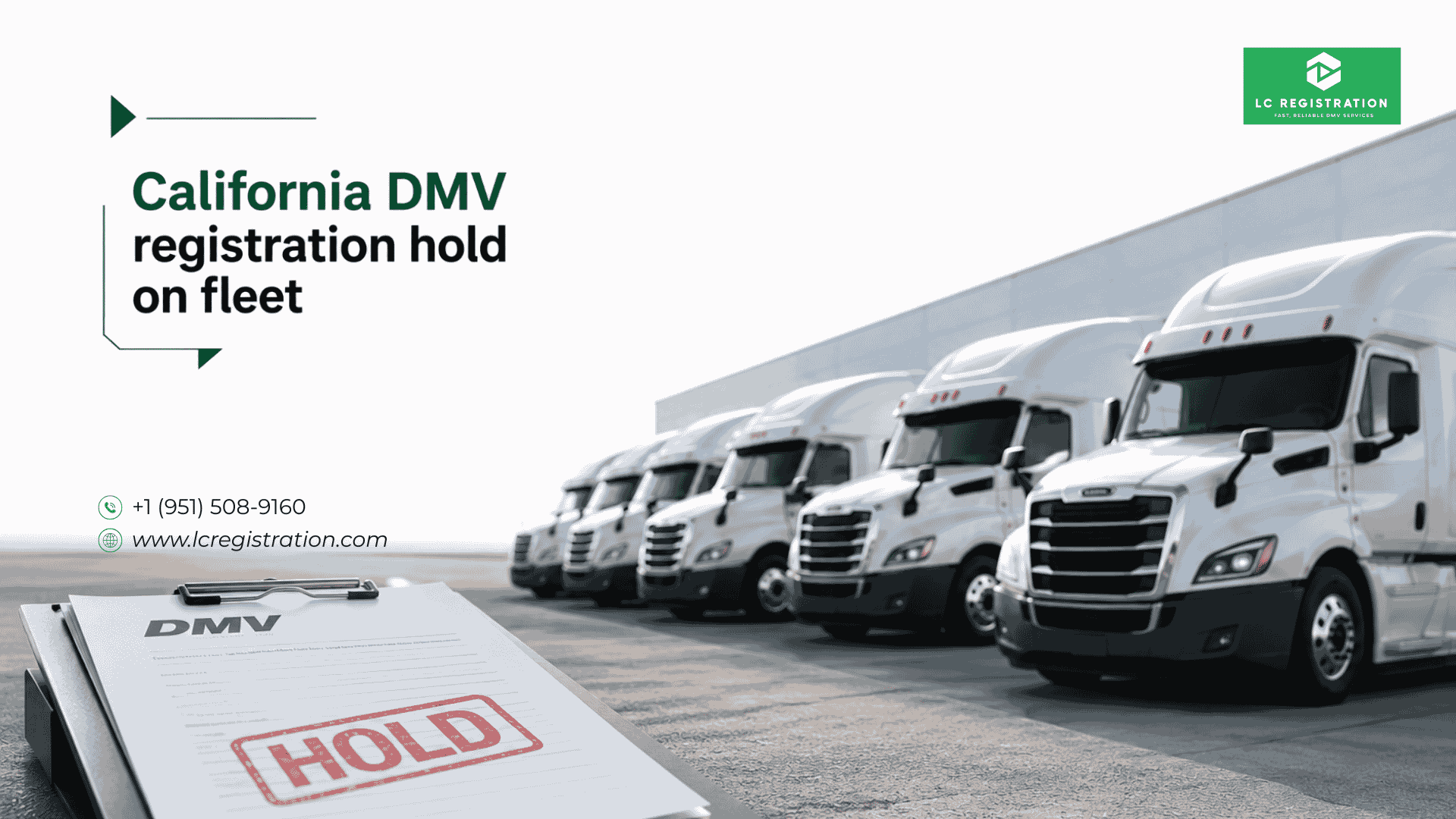
- What happens if missed: CARB notifies the DMV and places a registration hold on the vehicle
What Does a Registration Hold Mean?
A CARB-triggered registration hold:
- Prevents the vehicle from being registered or renewed at the DMV level
- Cannot be removed until the CARB issue is fully resolved and all fees are paid
- Takes an additional 1 to 3 business days to clear from the DMV’s system, even after the CARB issue is fixed
For fleets not actively monitoring CARB compliance deadlines, this hold is typically discovered at renewal, not before. That means correcting the CARB issue, waiting for the system to update, and then completing the DMV renewal, all while the truck remains grounded.
The Motor Carrier Permit Renewal Window Is Tighter Than Most Carriers Realize
Any motor carrier transporting property for compensation on California public highways must maintain a valid California Motor Carrier Permit (MCP) issued by the DMV.
Here is why the renewal window is more stressful than it appears:
MCP Renewal Timeline | Details |
Renewal notice sent | ~45 days before expiration |
DMV processing time | Up to 30 days after submission |
Actual working window | As little as 15 days once documents are gathered |
Risk if missed | Permit expires before renewal is processed |
Consequence of an expired MCP:
Operating without a valid MCP in California can result in immediate out-of-service orders, significant fines, and trucks being grounded until the permit is reinstated. The MCP renewal window requires attention and preparation well in advance, not a last-minute reaction to an expiration notice.
How Outsourcing Removes These Bottlenecks
Outsourcing fleet registration creates three fundamental operational improvements:
- Specialized work moves to dedicated professionals – rather than internal staff who carry competing priorities
- Errors are caught before submission – not after a rejection arrives from the DMV
- Deadlines are managed proactively – not reactively, after a compliance notice triggers a scramble
New truck onboarding moves faster as well. When a carrier adds a vehicle to the fleet and outsources title work, registration, and permit acquisition to a structured team, the gap between acquiring a vehicle and activating it operationally shortens, so equipment starts generating revenue sooner rather than sitting in the yard waiting on paperwork.
Why LC Registration Is the Right Partner for California Fleets
Without a dedicated registration process, the admin burden typically looks like this:
- Phone calls to the DMV during peak hours
- Manual spreadsheets tracking a dozen different renewal dates
- Reactive scrambles every time a compliance notice arrives in the mail
- Managers pulled away from operations to chase down missing documents
With LC Registration managing the workflow, that entire layer of back-office pressure is removed.
Your team stops reacting to registration problems and starts focusing on the work that actually grows the business. Here is what working with LC Registration looks like in practice:
- Proactive Renewal Management: Your MCP, IRP, and base plate expiration dates are tracked and filed well ahead of the DMV’s 30-day processing window, so your fleet never faces an expiration-related shutdown
- CARB Compliance Coordination: Your fleet’s Clean Truck Check compliance status is monitored continuously, coordinating between CARB requirements and DMV registration to help you avoid unexpected registration holds before they happen
- Error-Free Application Review: Every filing goes through a detailed accuracy check before submission, eliminating the rejected application cycle that delays truck activation and wastes internal time
- IRP and Multi-State Filing Support: IRP apportioned registration filings are handled with accurate mileage and fee calculations across all applicable jurisdictions for carriers operating beyond California’s borders
- Faster Equipment Onboarding: When new trucks are added to the fleet, title work, registration, and permits are processed in a structured, simultaneous workflow that gets vehicles road-ready faster
- Centralized Documentation: Organized records are maintained for every vehicle in your fleet, so renewal notices, compliance documentation, and filing history are always accessible when you need them
Every hour spent on rejected filings, compliance holds, missed renewals, or registration follow-up is an hour not spent moving freight. LC Registration removes that administrative weight so your team can focus on keeping trucks on the road and customers satisfied.
Ready to take registration off your plate? Contact LC Registration today and let our California compliance specialists handle the rest.
Frequently Asked Questions
What does LC Registration handle for California trucking companies?
LC Registration manages the full fleet registration and compliance workflow, including DMV titling and registration, Motor Carrier Permit renewals, CARB compliance coordination, IRP filings, base plate renewals, and related document management for California commercial fleets.
How does CARB affect my DMV registration in California?
Under the Clean Truck Check program (SB 210), heavy-duty vehicles with a GVWR over 14,000 lbs must pay annual compliance fees and pass emissions inspections. If these requirements are not met, CARB places a hold on your DMV registration that prevents renewal, and clearing the hold takes an additional 1 to 3 business days after the CARB issue is resolved.
What happens if my Motor Carrier Permit expires?
Operating in California without a valid MCP can result in out-of-service orders, fines, and grounded trucks. Because MCP renewals can take up to 30 days to process, it is critical to start the renewal process as soon as the 45-day notice window opens.
Is outsourcing fleet registration worth it for mid-sized fleets?
Absolutely. Mid-sized fleets often face the greatest administrative strain because the registration workload has grown, but the team structure has not kept pace. Outsourcing gives these carriers a structured, professional process without requiring them to hire and train dedicated in-house compliance staff.
How does outsourcing prevent rejected DMV filings?
Registration specialists review every application for accuracy before submission, checking VINs, fee calculations, insurance documentation, and required signatures, which dramatically reduces the likelihood that an application will be rejected and sent back for correction.