If your driver just got pulled over for an expired plate on a truck you forgot to renew, you’re not alone. Managing individual registrations across a growing fleet is one of the most overlooked operational headaches in California trucking. Every new vehicle you add to your business quietly adds another expiration date, another renewal notice, and another trip to the DMV.
So, when does it make sense to stop managing individual registrations and consolidate everything under fleet vehicle registration in California? That’s exactly what we’re breaking down here.
What Is Individual Vehicle Registration?
Individual vehicle registration is the standard process most businesses start with. Each commercial vehicle is registered separately, carries its own expiration date, and requires its own renewal cycle through the California DMV.
For owner-operators or businesses running 1 to 4 trucks, this approach works well. The paperwork is manageable, the costs are straightforward, and the process is familiar. But the moment your fleet starts growing, individual registration starts working against you.
Here’s the hidden challenge most businesses don’t see coming: each vehicle has its own timeline. That means your office team is constantly juggling staggered renewal dates throughout the calendar year. Miss one, even by a few days, and you’re looking at late fees, potential penalties, and worse, a truck that can’t legally stay on the road.
What Is Fleet Vehicle Registration?
Fleet registration consolidates multiple commercial vehicles under a single, unified registration program rather than managing each one separately. Instead of tracking a dozen different expiration dates, your entire fleet operates under one administrative structure with synchronized billing and renewals.
For California businesses specifically, the most powerful version of this is the California DMV’s Permanent Fleet Registration (PFR) Program. Under PFR, qualifying fleets can eliminate annual renewal requirements, meaning no renewal notices, no staggered expiration dates, and no surprise lapses.
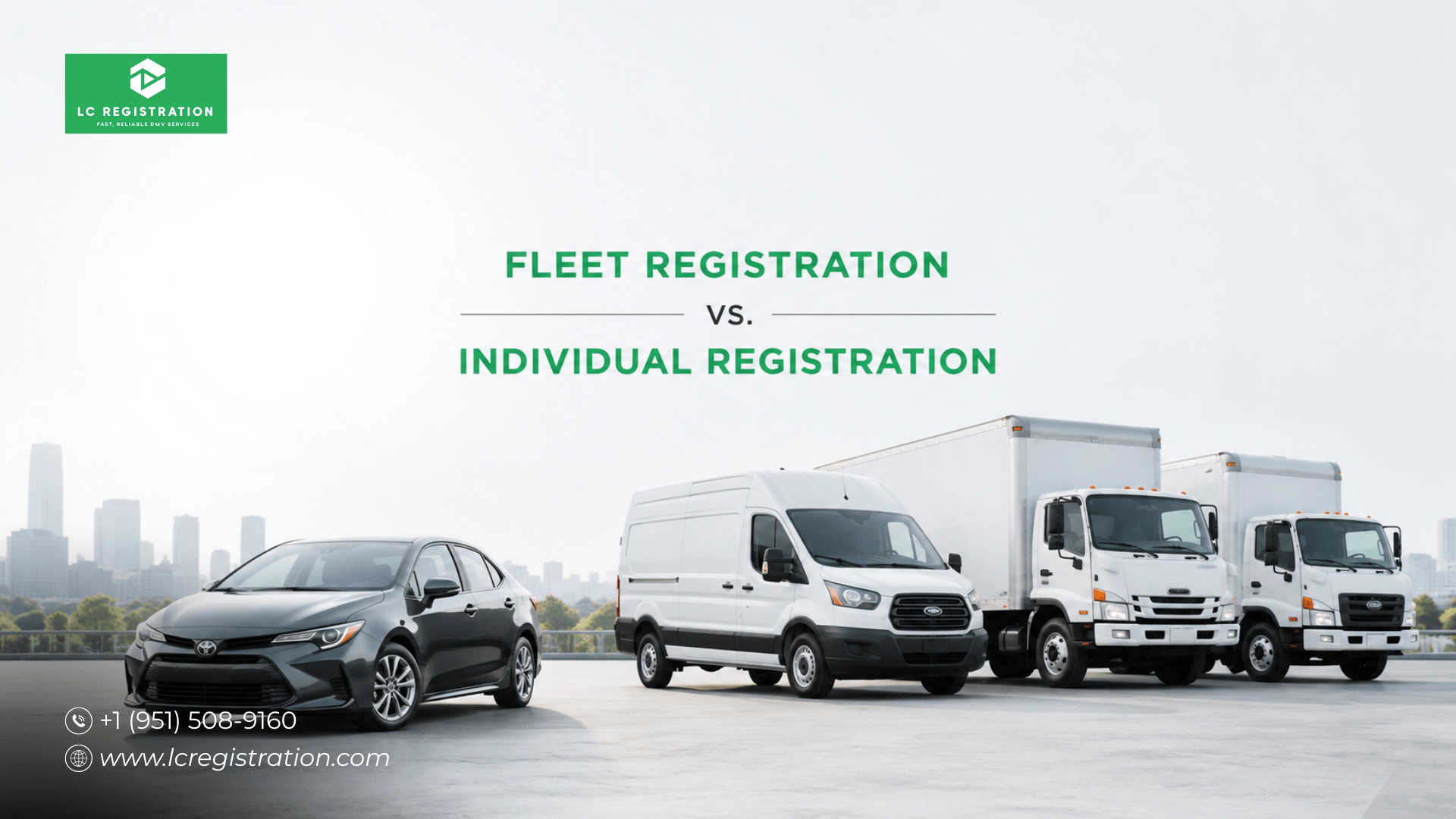
Individual vs. Fleet Vehicle Registration in California - Side-by-Side Breakdown
Feature | Individual Registration | Fleet Registration |
Renewal Cycle | Staggered – different dates for every vehicle | Consolidated – single billing cycle for all vehicles |
Administrative Effort | High – constant manual tracking required | Low – managed under one unified program |
Risk of Lapsed Plates | High – easy to miss individual renewals | Minimal – systemized alerts and batch processing |
DMV Visits | Required per vehicle, per renewal | Eliminated when managed by experts |
Cost Predictability | Unpredictable – scattered fees throughout the year | Predictable – single, consolidated expense |
Ideal Business Size | 1–4 commercial vehicles | 5+ commercial vehicles |
Permanent Registration Option | Not available | Available in California through the PFR Program |
The Real Cost of Staying on Individual Registration Too Long
Most businesses don’t realize the true cost of staying on individual registrations until the damage is already done. It rarely shows up as one large expense, it quietly accumulates in ways that are easy to overlook.
The Hidden Time Drain on Your Team
Think about the time your office staff spends just tracking plates. Pulling up renewal notices, logging into the DMV portal for each vehicle, cross-checking insurance documents, scheduling appointments – for a fleet of 10 trucks, this could easily consume several hours every single month. That’s time your team could be spending on operations, dispatch, or customer relationships.
The Financial Penalties That Sneak Up on You
A single lapsed registration can result in DMV fines. If your vehicle is caught operating with an expired plate, you’re also facing citations, potential impoundment, and the cost of getting that truck back on the road. For a commercial vehicle that generates revenue every day it runs, even a 48-hour grounding has a real dollar value.
The Compounding Problem as Your Fleet Grows
Every new truck you add multiplies the administrative chaos. What was manageable at three vehicles becomes genuinely unworkable at eight or ten. If your business is growing, individual registration will eventually become a bottleneck rather than just a nuisance.
When Is the Right Time to Switch to Fleet Registration?
There is no single universal answer, but there are clear signals that tell you it’s time to make the move.
The 5-vehicle threshold is a practical rule of thumb. Once your fleet reaches five or more commercial vehicles, the administrative savings and compliance benefits of fleet registration clearly outweigh the setup effort. At this point, consolidated management is no longer a luxury, it’s an operational upgrade.
Beyond vehicle count, watch for these specific triggers:
- Your first late fee or lapsed plate – This is the clearest sign that manual tracking has exceeded your team’s bandwidth.
- A business loan application: lenders want organized, auditable asset documentation; a scattered registration history creates friction.
- An insurance audit – Insurers prefer structured fleet policies and may question inconsistencies across individually registered vehicles.
- A DOT compliance review – Operating with any lapsed or incorrectly titled vehicle during an audit can have serious consequences.
- A title transfer after a vehicle purchase – The moment you’re buying and selling trucks, getting the titling right from day one matters.
How LC Registration Handles the Transition for You
Switching from individual to fleet registration sounds complicated. It doesn’t have to be – especially when you’re working with a team that handles this every day.
Here’s what the process typically looks like when you work with LC Registration:
Fleet Audit: We review your existing registrations, titles, and entity documentation to identify what’s current, what’s lapsed, and what needs correction before enrollment.
Title Consolidation: Any titles registered under the wrong entity or carrying liens that need updating are addressed upfront, so there are no surprises down the road.
Program Enrollment: Based on your fleet size and business type, our vehicle registration services enroll you in the appropriate program – including California’s PFR for qualifying fleets. And if you’d like to see exactly how enrollment works, walk through the step-by-step process for Permanent Fleet Registration to see exactly how enrollment works.
Unified Billing Setup: All vehicles move to a single billing cycle, so your team no longer has to chase individual renewal notices.
Ongoing Compliance Management: As you add new vehicles, LC Registration handles each addition under your existing fleet structure without starting from scratch.
Because LC Registration is an authorized DMV registration services provider, the entire process is handled without your team having to set foot in a DMV office: no queues, no confusion, no back-and-forth over missing documents. Whether you’re managing 5 trucks or 50, we’ll handle the paperwork so you can stay on the road.
Ready to stop managing registrations one truck at a time? Contact LC Registration today and let’s build a registration structure that grows with your business – not against it.
Frequently Asked Questions
What is the difference between fleet registration and individual vehicle registration in California?
Individual registration means each commercial vehicle is registered separately with its own renewal date, paperwork, and DMV visit required annually. Fleet registration consolidates all your vehicles under a single account, with synchronized billing and a single administrative process.
When should a business stop registering vehicles individually and switch to fleet registration?
A practical rule of thumb is five or more commercial vehicles. At that point, the administrative savings, reduced risk of lapsed plates, and cost predictability of fleet registration clearly outweigh the effort required to switch. Other clear triggers include your first late fee, a business loan application, an insurance audit, or a DOT compliance review.
Can a small trucking business use fleet registration, or is it only for large carriers?
Fleet registration is not reserved for large carriers. Any California business operating five or more commercial vehicles can benefit from a consolidated fleet program. LC Registration works with businesses at every stage – from owner-operators adding their fifth truck to established logistics companies managing hundreds of vehicles.
Does fleet registration save money compared to individual registration?
The direct registration fees are often similar, but the real savings come from eliminating late fees due to missed renewals, reducing the administrative staff time spent tracking individual plates, and avoiding fines from non-compliance. For businesses applying for commercial financing, a clean and organized fleet registration structure can also reduce friction and speed up loan approvals.
What documents are needed to enroll in a fleet registration program?
Typically, you will need current titles for all vehicles, proof of business entity documentation (LLC, corporation, etc.), proof of insurance, and any existing registration records. LC Registration reviews all documentation upfront to identify and resolve any discrepancies before enrollment.