Most DMV business can now be started or finished without setting foot in an office. The problem is that “online” isn’t one thing, and picking the wrong channel is how people end up in a queue they didn’t need to join.
There are five ways to get DMV business done in California in 2026. Here’s what each one handles, what changed this year, and the short list of transactions that still require a counter.
Five channels, not two
Channel | Best for | Appointment needed |
Renewals, address changes, records, paperless notices | No | |
Virtual Field Office | Transactions needing document review and e-signature | No |
DMV Now kiosks | Stickers, renewals, records | No |
By mail | Renewals and certain forms | No |
Business partner | Complex titles, transfers, fleet and commercial work | No |
DMV field office | Everything left | Recommended |
Almost every article on this topic treats it as “online versus the DMV.” That framing costs people time, because the middle three channels handle a lot of what they assume requires a visit.
What you can finish in MyDMV
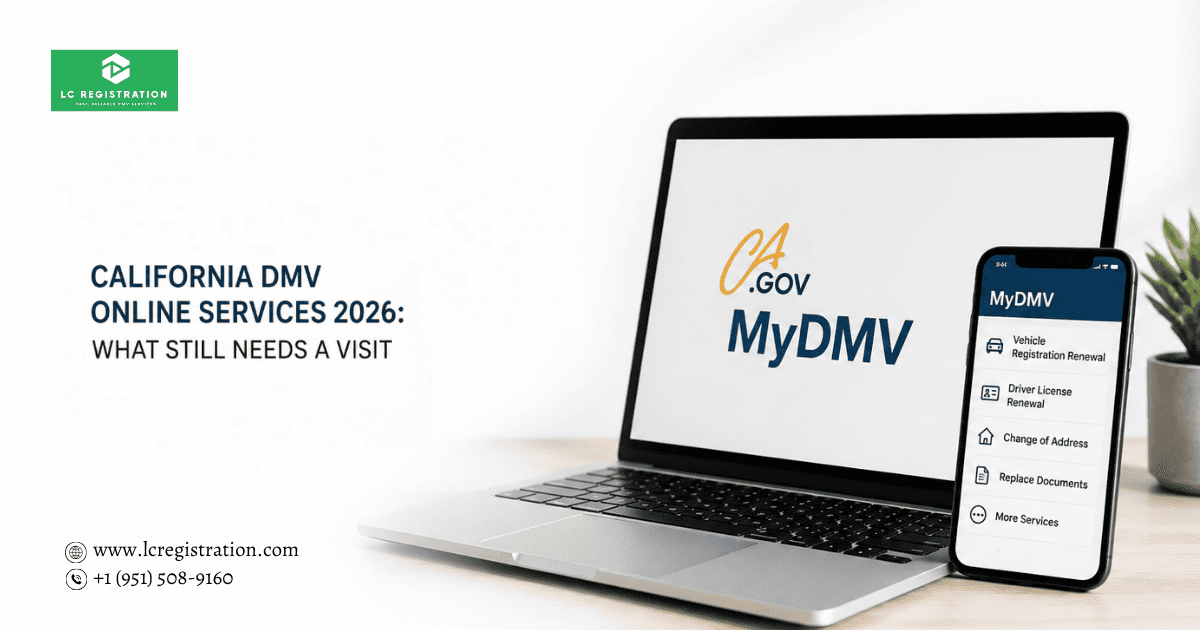
MyDMV is a free account at dmv.ca.gov and the hub for most self-service transactions:
- Vehicle registration renewal — plate number, VIN, insurance on file, done in minutes
- Change of address — licence and vehicle records in the same session (do both; they’re separate records)
- Driver and vehicle record requests
- Driver’s licence renewal, where you’re eligible
- Paperless notices — get renewal reminders by email instead of post
One important limitation: MyDMV requires a current California driver’s licence or ID card, a Social Security number, and a US address. If you don’t have all three, this channel is closed to you — you’d file by mail or through a business partner instead. If that’s your situation, our guide on registering a car without a California licence covers the alternatives, and address changes go on a DMV 14 form as explained in our registration address change guide.
What the Virtual Field Office handles
This is the channel most Californians have never heard of, and it’s the useful one.
The Virtual Field Office at virtual.dmv.ca.gov exists for transactions that need a DMV employee to actually look at your documents. You upload them, provide an e-signature where required, and pay by e-check. It covers:
- Vehicle title transfers and duplicate titles
- Complex registration renewals requiring additional documentation
- Partial-year registration for commercial vehicles
- Commercial driver medical certificates
- Status checks on pending transactions
If your renewal was rejected online because something needed reviewing, this is usually where it should go next, not to a field office.
The CA DMV Wallet: your licence, and now your title
Two digital credentials are worth knowing about in 2026.
Mobile driver's licence
The mDL is a free, voluntary digital version of your licence or ID, available in the CA DMV Wallet app and in Apple, Google, and, since April 2026, Samsung Wallet.
The big change this year: SB 169, signed on July 13, 2026, raised the pilot cap from 15% to 60% of California’s licensed drivers. That’s roughly 17 million people now eligible, up from a fraction of that. More than 3.5 million Californians have applied since the programme launched in 2023.
You can use it at participating TSA checkpoints and for age verification. It does not replace your physical licence. Keep carrying the card, the mDL is an added option, not a substitute, and acceptance is still uneven outside the specific use cases it’s built for.
California Vehicle Credential
Less publicised and arguably more useful if you own a vehicle: the CA DMV Wallet can now hold your vehicle title.
For vehicles linked to your licence, you can add a vehicle credential and use it to show and verify ownership to a potential buyer, a dealership, or law enforcement. It sits on top of the 42 million California titles the DMV digitised in 2024.
It doesn’t eliminate the paper title from every transaction, but it does mean a misplaced title is far less of a crisis than it used to be. Our California DMV eTitle guide covers how electronic titles work in practice, and if you need a paper replacement, that’s a duplicate title.
What still requires an office visit
Short list, but firm:
- A first California driver’s licence
- A first REAL ID
- The behind-the-wheel drive test
- The CDL skills test
- Paying in cash
- Driver’s licence renewal at age 70 or older
- VIN verification
- New-resident and out-of-state vehicle registration, because the VIN check and document review are physical
That last one catches new arrivals out constantly. If you’ve just moved here, read our guide on what documents new California residents need to register a vehicle before you start booking anything.
Where a licensed registration service fits
Worth being direct about this, since you’re reading it on one.
DMV-authorized business partners are private companies permitted to process registration and title transactions. We are not a government agency, and we charge a service fee for our work. The DMV says as much on its own site, and you should know it before you call anyone.
What that buys you is the transactions the self-service channels won’t complete: complex or commercial paperwork, fleet registration across multiple vehicles, titles held by a lienholder, and filings for anyone locked out of MyDMV.
And the honest flip side: if you just need a standard registration renewal and you have a MyDMV account, do it yourself. It’s free and takes five minutes. If your sticker never arrived, start with our guide on that before assuming you need help.
Avoiding fake DMV sites
Worth two minutes, because this is a growing problem and the DMV runs an active warning about it.
- The official portal is dmv.ca.gov. The Virtual Field Office is virtual.dmv.ca.gov. Type them directly rather than clicking through a search ad.
- The DMV does not text or email you demanding immediate payment to avoid suspension. That’s a phishing message.
- Any site charging you a fee simply to book a DMV appointment is not the DMV, and isn’t providing a service.
Note the distinction: a licensed business partner charging a disclosed service fee for work it actually performs is a legitimate, DMV-authorized arrangement. A lookalike site harvesting your card details is not. If you’re unsure, the DMV publishes a directory of authorised business partners.
Frequently Asked Questions
Can I renew my vehicle registration entirely online?
Usually yes, through MyDMV, provided your registration isn’t suspended and nothing extra needs reviewing. Complex renewals route to the Virtual Field Office.
What's the difference between MyDMV and the Virtual Field Office?
MyDMV is self-service for standard transactions. The Virtual Field Office is for transactions where a DMV employee has to review uploaded documents.
Do I need a Social Security number to use DMV online services?
For MyDMV, yes, along with a California DL/ID and a US address. Registration itself doesn’t require an SSN.
Does a mobile driver's licence replace my physical licence?
No. Keep carrying your card.
Can I transfer a vehicle title online?
Title transfers and duplicate titles can be submitted through the Virtual Field Office. Complex transfers are often faster through a licensed title transfer service.
Can I register an out-of-state vehicle online?
No. VIN verification has to be done in person.
DMV services change fast, this guide reflects what’s available as of the verification date above. If your transaction isn’t on the self-service list and you’d rather not queue for it, contact LC Registration.