Selling a vehicle or purchasing a new one often raises an important question for California drivers: What happens to a personalized license plate?
Many vehicle owners are unsure whether vanity plates can be transferred, sold, or retained when changing vehicles, which can lead to DMV mistakes, delays, or even plate cancellation.
This guide explains California DMV rules on transfers, restrictions, required forms, and timelines, helping you understand how vanity plates work in California and how to manage them correctly while staying fully compliant with state regulations.
Can You Transfer a Vanity Plate to Your Own Vehicle?
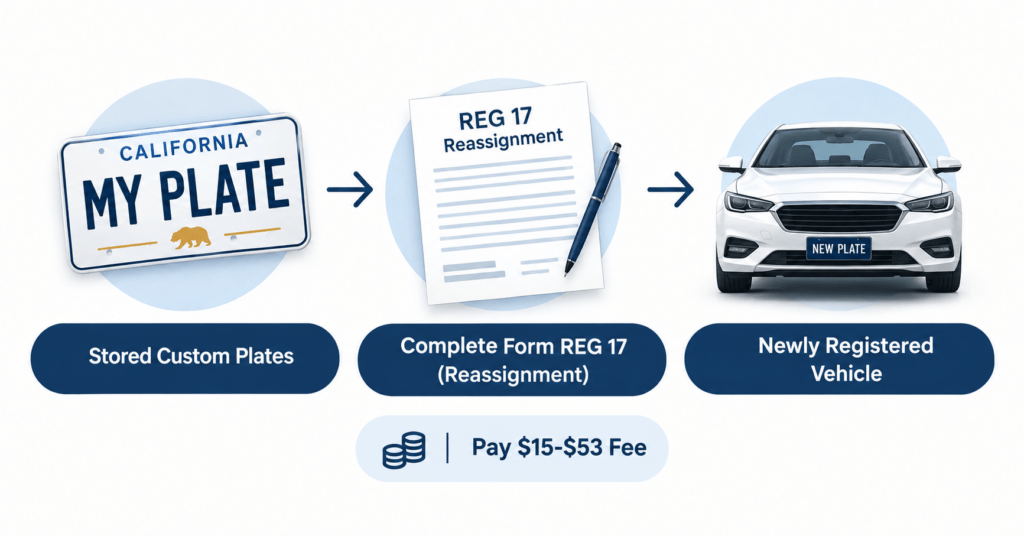
Yes, you can transfer a vanity plate (personalized or special interest license plate) to another vehicle you own in California. The California DMV process uses Form REG 17 (Special Interest License Plate Application) to reassign the plate to you as the vehicle owner.
Ownership Requirements
- Same Owner Rule: California license plates attach to the vehicle owner, not the car itself. You must own or be a listed co-owner on both the old vehicle (where the plate is removed) and the new vehicle (where the plate is attached).
- Active Registration Status: The receiving vehicle must be registered in California with current tags and cannot be on Planned Non-Operation (PNO) status.
Process Overview
- Complete DMV Form REG 17, marking Section 4 for Reassignment.
- Note the Vehicle Identification Number (VIN) of the old vehicle for plate removal and the VIN of the new vehicle for plate attachment.
- Detach physical plates from the old vehicle before transferring title or selling the car.
Vanity Plate Transfer & Retention Costs
Transaction Type | DMV Fee Range | Purpose & Rules |
Sequential Reassignment | $15 | Standard special-background plate reassignment |
Personalized Reassignment | $38-$53 | Moving custom-text plates to a replacement vehicle |
Annual Retention Fee | $25-$78/year | Retaining unused custom plates without a vehicle |
Fee Structure & Required Documents
- Reassignment Fees: Reassignment fees vary by plate style, typically $15 for sequential special interest plates or $38–$53 for personalized plates (like 1960s Legacy, Environmental, Arts, or Lake Tahoe plates).
- Annual Retention: An additional retention fee ($25–$78/year depending on plate type) applies if holding plates unused in storage; failure to pay this annual surcharge cancels your reservation of the text configuration. These fees are charged in addition to standard California DMV vehicle registration renewal fees.
- Required Documents: You will need both vehicle registration cards, a valid government-issued photo ID, proof of California vehicle insurance, and the physical license plates.
Submission Options & Timelines
- Submission Methods: Applications can be submitted by mail or in person at DMV offices. To skip long field office wait times, you can also process plate transfers through an authorized DMV partner.
- Timeline Considerations: Processing takes 8 to 12 weeks for personalized plates handled through state mail. If your vehicle registration expires within 30 days, renew it prior to reassignment to avoid delinquency fines or administrative holds.
What Are the Transfer Requirements and Restrictions for a Vanity Plate in California?
Transferring a vanity plate in California requires following specific DMV rules to ensure the process is legal and smooth:
Same Owner Requirement: Plates can only be reassigned to vehicles registered under the same license plate owner’s name. Plates cannot be transferred or assigned to an unrelated third-party buyer.
Up-to-Date Registration Status: All past-due renewal fees, smog checks, and unpaid traffic or parking violations associated with the plate or vehicle must be paid in full before a transfer can take place.
Vehicle Classification Restrictions: Certain vanity plates are designated for specific vehicle types (such as auto vs. motorcycle vs. commercial truck). Transferring a plate across different vehicle classes may require surrendering the plates and issuing a new configuration.
Replacing Old Vehicle Plates: When selling or trading in your previous car, you must equip that vehicle with standard sequential plates before releasing possession.
Can You Sell or Transfer a Vanity Plate to Another Person in California?
In California, the general rule is that vanity plates cannot be sold or transferred to another person on secondary markets. State law prohibits selling personalized plate configurations for profit to protect the integrity of the DMV registration system.
However, the DMV permits limited non-commercial transfers between specific family members and legal entities:
Allowed Family & Legal Transfer Exceptions
Qualified Relationship | Required Form & Verification |
Spouses | Form REG 17 signed by both parties + Form REG 256 |
Parents / Children | Form REG 17 + Form REG 256 Statement of Facts |
Grandparents / Grandchildren | Form REG 17 + Form REG 256 verifying relationship |
Inheritance / Estate | Form REG 5 (Affidavit for Transfer Without Probate) or court documentation |
- Spouses & Direct Family: Plates can be transferred between husband/wife, parent/child, or grandparent/grandchild. Both parties must sign Form REG 17, and Form REG 256 (Statement of Facts) must be attached to document the family relationship.
- Inheritance: Upon the passing of the plate owner, legal heirs can inherit the vanity plate configuration using DMV Form REG 5 or court probate documentation.
- Divorce Settlements: Vanity plates remain with the original applicant unless formally released using a signed release of priority on Form REG 17.
Important: Selling a vanity plate configuration for money or advertising it on auction sites is illegal under California law. Attempting to sell a plate can result in the DMV permanently canceling the configuration.
What Happens When You Sell Your Vehicle in California?
Before selling your vehicle in a private transaction or dealer trade-in, you must unbolt and remove your vanity plates. Vanity plates do not automatically transfer to the buyer with the car.
When selling a car with custom plates, you have three options:
- Reassign to New Vehicle: Transfer the plates immediately to a replacement car using Form REG 17.
- Retain for Future Use: Pay the annual retention fee to store the plate configuration with the DMV until you acquire a new vehicle.
- Release / Surrender: Release priority back to the DMV or surrender the physical plates if you no longer want the configuration.
If you are also completing an online ownership change for the car you just sold, use our guided California online car title transfer service to submit buyer and seller documentation quickly without visiting a DMV field office.
What Is the Step-by-Step Process to Transfer a Vanity Plate in California?
Transferring your vanity plate is straightforward when you follow these four steps:
Step 1: Complete Form REG 17: Fill out Sections 1, 2, and 4 of DMV Form REG 17. If transferring to a qualifying family member, complete Form REG 256 as well.
Step 2: Gather Required Documentation: Collect both vehicle registration cards, valid driver’s licenses, proof of insurance, and the physical vanity plates.
Step 3: Submit Application & Pay Reassignment Fees: Submit your paperwork by mail, at a DMV office, or through an authorized DMV partner, paying the $15–$53 reassignment fee.
Step 4: Attach Updated Registration & Mount Plates: Once processed, you will receive an updated registration card linking the custom plate to your new vehicle. Securely mount the plates onto your replacement car.
Simplify Your Plate Transfer with LC Registration
Managing custom plate reassignments, family transfers, and vehicle registration updates doesn’t have to mean long DMV lines or paperwork confusion.
As a licensed California DMV partner, LC Registration provides expert assistance for personalized plate retention, title transfers, and fast vehicle renewals.
Call LC Registration at (951) 508-9160 or contact us online today for fast, stress-free DMV plate transfer assistance!
FAQs About California Vanity Plates
1. Can vanity plates be transferred to another vehicle in California?
Yes. You can transfer vanity plates to another vehicle registered in your name by submitting DMV Form REG 17 and paying the $15–$53 reassignment fee.
2. Can you sell a personalized or vanity license plate in California?
No. California law strictly prohibits buying or selling vanity plate configurations between private parties. Plates can only be transferred between qualifying family members (spouse, parent, child, grandparent) or through legal inheritance.
3. What is the cost of transferring vanity plates in California DMV?
Reassignment costs $15 for standard sequential special plates and $38-$53 for personalized custom text plates. If holding the plates unassigned without a vehicle, an annual retention fee of $25-$78 applies.
4. What is the time frame for transferring vanity plates in California?
Standard mail processing through the DMV takes approximately 8 to 12 weeks. Utilizing an authorized DMV partner speeds up document verification and avoids processing rejections.
5. Can you retain or reserve a vanity plate after selling your vehicle in California?
Yes. By marking the “Retention” box on Form REG 17 and paying the annual retention fee, the DMV holds your custom plate configuration in storage so no one else can claim it while you are between vehicles.